
News
Prize-Winning Works of East Asian Experimental Competition 2023
This year’s “East Asian Experimental Competition” received a total of 400 submissions from Japan, China, Taiwan, Hong Kong, Macau and South Korea, and after two carefully conducted rounds of screening 32 works were selected for nomination. The final evaluation was conducted during the screenings in Tokyo by the three jurors listed below.
On 6th October, award ceremony has held at Theatre Image Forum, and 6 works were awarded prizes and 1 work was selected by the audience’s voting, it’s as below.

>> from left to right: ENDO Maiko (Jury) / Mark TOSCANO (Jury) / XU Yuan (Director “Sewing Love”) / NOSE Daisuke (Director “/laɪkawaːʔ/”) / HOSAKA Kenjiro (Jury)
■ Prize-Winning Works and Jury’s comments
Grand Prize
No changes have taken in our life XU Jingwei / digital / 44min. / 2022 (China)
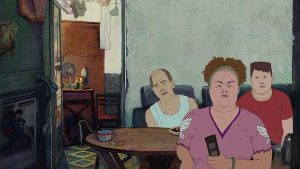
This film impressed all of us with its nuanced and patient observational approach to depict the psychologically affecting landscape of a contemporary young person’s perspective in contemporary China. The film uses a memorable combination of lushly painted backgrounds and unstable, emotive character animation to express the existential confusion of the main character with dark humor and poetic pathos. The touches of surrealism and absurdity also effectively contribute to the film’s strange and memorable power, creating a world in which an individual is both disturbed and curious about the uncertain world around him.
TERAYAMA Shuji Prize
Delivery Dancer’s Sphere Ayoung KIM / digital / 26min. / 2023 (Korea)
 It was as if looking in to the world, spinning the sphere that appears in the beginning of the film. Inside the sphere is a labyrinth, the flow of time is uncertain. An only a true dancer can make a crack in the world as it goes around and around. In order to escape from the world and to break free of that karma, self-annihilation is necessary. The story told in this film was very classic and poetic, while seeking a new way of expression using the newest technology. The juries decided it was appropriate for the name of Shuji Terayama.
SHIBUYA SKY Prize
Sewing Love XU Yuan / digital / 9min. / 2023 (China / Japan)
 The film employs a highly creative animation style, combined with an eclectic and perfectly suited soundtrack, to express the spectacular, dramatic emotions of a young romance that evolves into something much more insidious. The use of color and texture is unique and effective, the film is full of visual surprise and creativity, and the emotional resonance of the film’s themes is vividly communicated by the artist.
Award for Excellence
An Asian Ghost Story Bo WANG / digital / 37min. / 2023 (China / Netherlands)
 The film takes up the fact that wigs were deeply involved in the economic development of postwar Asia, a fact almost forgotten perhaps by most of the people. While a film can represent things easily as a mere fact, this work sometimes includes scenes can be taken as fiction. This work reminds us the uncertainess and the decieving quality of the film media. The work shows us the effectiveness of what could be called the “research-based art with fiction”. The director has also created installation works, and this work was also exhibited as an installation in Hong Kong. In the future, we look forward to seeing more works by the director that appeal to the viewer’s body sensation.
The Perfect Human Lilan Yang / digital (original format: 16mm) / 13min. / 2023 (China / USA)
 We were amazed by the structure of the film, as it visually translates (or paraphrases) the ironic notion “perfect human” of the 1968 film using unsupervised machine learning, an AI technology that is expected to be “perfect” at all times. Perhaps the appeal of this work, which more than makes up for the weakness of its inability to convey the true meaning of the work without comparison to the original film and its making process, comes from the monochrome and tactile texture of the images. We look forward to the future of this artist’s work, which boldly tackles the new visual language.
/laɪkawaːʔ/ NOSE Daisuke / digital / 2min / 2023 (Japan)
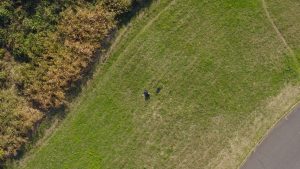 Practicing scales is boring. But watching this film, maybe the very fact of it could be a precious thing in itself, and that someone somewhere exists so peacefully in such a meadow, and that it is our earth, which makes us feel a little warm. And then we realize the trick of those eyes from “the heaven”, and then we are left just astonished.
Audience Award in Tokyo
Sewing Love XU Yuan / digital / 9min. / 2023 (China / Japan)
Audience Award in Kyoto
I stitch my skin to the ground USAMI Nao / digital / 22min. / 2023 (Japan)
Audience Award in Nagoya
LETHE GOSHIMA Kazuhiro / digital / 21min. / 2023 (Japan)
■ Final Evaluation Jury
ENDO Maiko (film director and artist / Japan)
HOSAKA Kenjiro (director, Shiga Museum of Art / Japan)
Mark TOSCANO (curator, film preservationist, and educator / USA)
2023.10.15
The works nominated for the “East Asian Experimental Competition” have been decided!
The “East Asian Experimental Competition” received a total of 400 submissions from Japan, China, Hong Kong, Macau, Taiwan and South Korea, and after two carefully conducted rounds of screening the following 32 works were selected for nomination. These nominated works will be screened at each venue of the 37th Image Forum Festival. The final evaluation will be conducted during the screenings at the Tokyo venue by the final jurors, and 7 of them will be awarded prizes.
2023.09.27

Copyright © Image Forum 2026 All rights reserved.